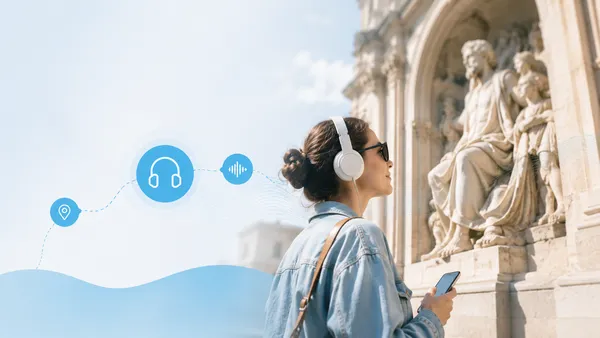
Every museum, historic site, or visitor attraction wants to offer an excellent experience to international guests. Yet translating an audioguide into multiple languages has traditionally been expensive, slow, and difficult to maintain. Artificial intelligence (AI) is changing that. With state-of-the-art AI models for translation and text-to-speech generation, high quality audioguides can now be provided affordably, making multilingual accessibility realistic even for smaller museums and cultural institutions.
Why translate your audioguide?
International tourism continues to grow, and visitors increasingly expect information in their own language. While English is widely spoken, many visitors feel much more comfortable experiencing exhibitions in their native language. Offering multilingual audioguides helps visitors:
- better understand exhibits and stories
- spend more time engaging with the exhibition
- enjoy a more inclusive experience
- leave with a stronger impression of the museum
A translated audioguide isn't just a convenience - it's an investment in visitor satisfaction!
Why use AI for translation?
Scalable for Future Growth
Expanding your audioguide into additional languages becomes straightforward with AI, without the need to restart the entire translation process from scratch. Once the original content is available, new language versions can be generated at any time, making it easy to grow alongside your audience or exhibition program.
This approach also ensures consistency over time. As your content evolves, AI helps preserve your institution's tone of voice and terminology across all languages, so every update remains aligned — no matter how many versions or languages you support.
Consistent, High-Quality Results
Modern AI translation and speech synthesis have reached a quality level that is ideally suited for informational and educational content such as audioguides. AI delivers natural-sounding translations and narration while maintaining a consistent tone, style, and pronunciation throughout an entire tour.
Because the same AI system is used every time, updates remain consistent even when new stops are added or existing content is revised months or years later. Unlike traditional workflows involving multiple translators or voice actors, AI helps avoid variations in terminology, writing style, or voice, ensuring a seamless listening experience for your visitors.
Fast Turnaround and Easy Updates
Traditional translation projects can take weeks to complete, making it difficult to keep pace with evolving exhibitions. In the meantime, exhibit descriptions may change, new stops may be added, or temporary and seasonal exhibitions may need multilingual content on short notice.
AI translation dramatically shortens turnaround times. New translations can often be created within hours instead of weeks, allowing museums to launch multilingual audioguides quickly and respond to changes without lengthy translation projects.
Keeping your audioguide up to date is just as straightforward. When content changes, only the affected sections need to be retranslated, making ongoing maintenance fast, affordable, and scalable as your collection and exhibitions evolve.
Broad Language Support
Modern AI models support dozens of languages, making it practical and affordable to offer multilingual audioguides to visitors from around the world. Languages that were once too costly or difficult to translate can now be included with minimal additional effort.
By opening up your content to a global audience, you make your exhibitions more accessible and inclusive while allowing more visitors to experience your exhibitions in their native language.
Cost-Effective
Translating an audioguide into multiple languages has traditionally required separate translators, voice actors, and audio production for each language. As the number of languages increases, so do the costs, often putting multilingual audioguides beyond the reach of smaller museums and cultural institutions.
AI translation and text-to-speech simplify this process by combining translation and narration into a single service with predictable costs. Overall AI significantly reduces production costs while maintaining high quality and making multilingual audioguides affordable for projects of any size.
AI Translation with SmartCompanion
We help museums and cultural institutions translate existing audioguides into multiple languages using state-of-the-art AI. The process is straightforward:
- Provide your existing audioguide texts.
- We translate them into the desired languages using modern AI.
- Optional review and refinement.
- Publish the translated versions directly with SmartCompanion or integrate them into your existing audioguide platform.
If you later extend your exhibition or update individual stops, the translations can easily be regenerated without repeating the entire project.
You can find all details on process, languages and costs on our AI audioguide translation page.