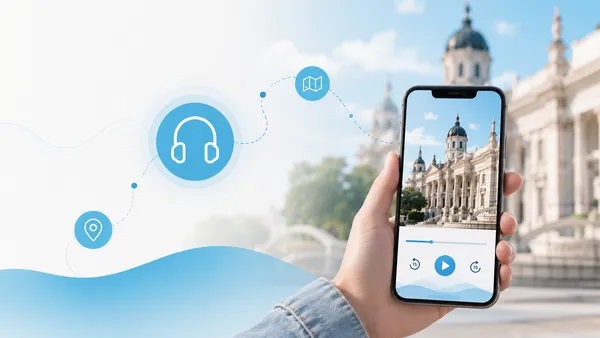
Museums and cultural institutions increasingly rely on digital tools to enhance the visitor experience. Audioguides have become a standard way to provide important information to visitors about exhibitions. As these systems become more advanced, one important question arises: Who controls your audioguide system — and what happens if you want to change it later? This is where an open-source audioguide system offers a fundamentally different approach.
What does "open source" mean?
Open source software is software whose source code is publicly available. Anyone can view how it works, modify it to their own needs and freely use it. Instead of being locked into a single vendor or proprietary system, institutions can host and run the software themselves or work with any developer or provider of their choice. In the case of SmartCompanion the source code is publicly available with a permissive BSD-2 license for download on GitHub.
Why does this matter for museums?
Museums typically think in decades. Exhibitions evolve, funding changes and digital tools come and go. A museum that installs an audioguide system today may still want to use or adapt parts of it ten years from now.
With traditional (closed-source) audioguide platforms, this could lead to a dependency on a single provider. Over time, this can create challenges such as:
- rising licensing or subscription costs
- limited flexibility in features or design
- difficulty in extending or adapting the content
- difficulty migrating content to another system
- dependency on the vendor’s roadmap and business decisions
Open source changes this dynamic, since the dependency on a single vendor is greatly reduced.
Avoid vendor lock-in and licensing costs
One of the most important advantages of an open-source audioguide is freedom of choice. Vendor lock-in occurs when a museum becomes dependent on a specific software provider, making it difficult or costly to switch systems later. With an open-source solution:
- data formats are transparent
- hosting can be moved anywhere
- development can be done internally or externally
- the code is accessible, allowing for customization and improvement
This means museums remain in control of their own digital infrastructure. They are not “renting” a system — they are owning it.
No dedicated hardware, no hidden costs
Traditional audioguide systems often come with a significant price tag: dedicated handheld devices, charging stations, headphones, cleaning and disinfection, replacement of lost or broken units, and staff time for handing out and collecting devices. These costs return year after year — on top of licensing fees.
An open-source audioguide like SmartCompanion runs on the visitor’s own smartphone. There is no hardware to purchase, maintain or replace, and no per-device license. The remaining cost is essentially hosting — which is minimal for a web app — and the one-time effort of preparing your content. For small and mid-sized museums in particular, this turns an audioguide from a major investment into an affordable standard feature.
A better experience for visitors
Visitors benefit as well. They use a device they already know, with their own headphones, and simply open the guide in the browser or scan a QR code — no waiting in line at the front desk and no unfamiliar hardware. Content can be offered in multiple languages at no additional hardware cost.
Accessibility is another strong argument: text transcripts alongside audio, adjustable playback, and compatibility with the smartphone’s built-in assistive features (such as screen readers and text scaling) make the exhibition more inclusive. With the European Accessibility Act now in force, this is not just good practice but increasingly a requirement for digital services in the EU.
Data privacy under your control
Because an open-source audioguide can be self-hosted, no visitor data needs to flow to a third-party platform. There is no tracking by an external vendor, and GDPR compliance is straightforward — an important point for public institutions.
How does it work in practice?
Getting started is simpler than many museums expect:
- You prepare your content: audio files, texts and images for each station — defined in an open data format
- Each station gets a number or QR code displayed in the exhibition
- The app is hosted as a web app — on your own server, your existing website hosting, or with a provider of your choice
- Visitors scan a code or enter a number and start listening
Since the content lives in an open, documented format, it can be updated at any time and reused in future systems — your work is never locked away.
Being honest: open source is not zero effort
Open source removes license fees and lock-in, but someone still needs to set up hosting and prepare the content. Museums with in-house technical staff can do this entirely on their own; others can work with any web agency — or with us. That freedom of choice is exactly the point: you decide who supports your system, today and in ten years.